
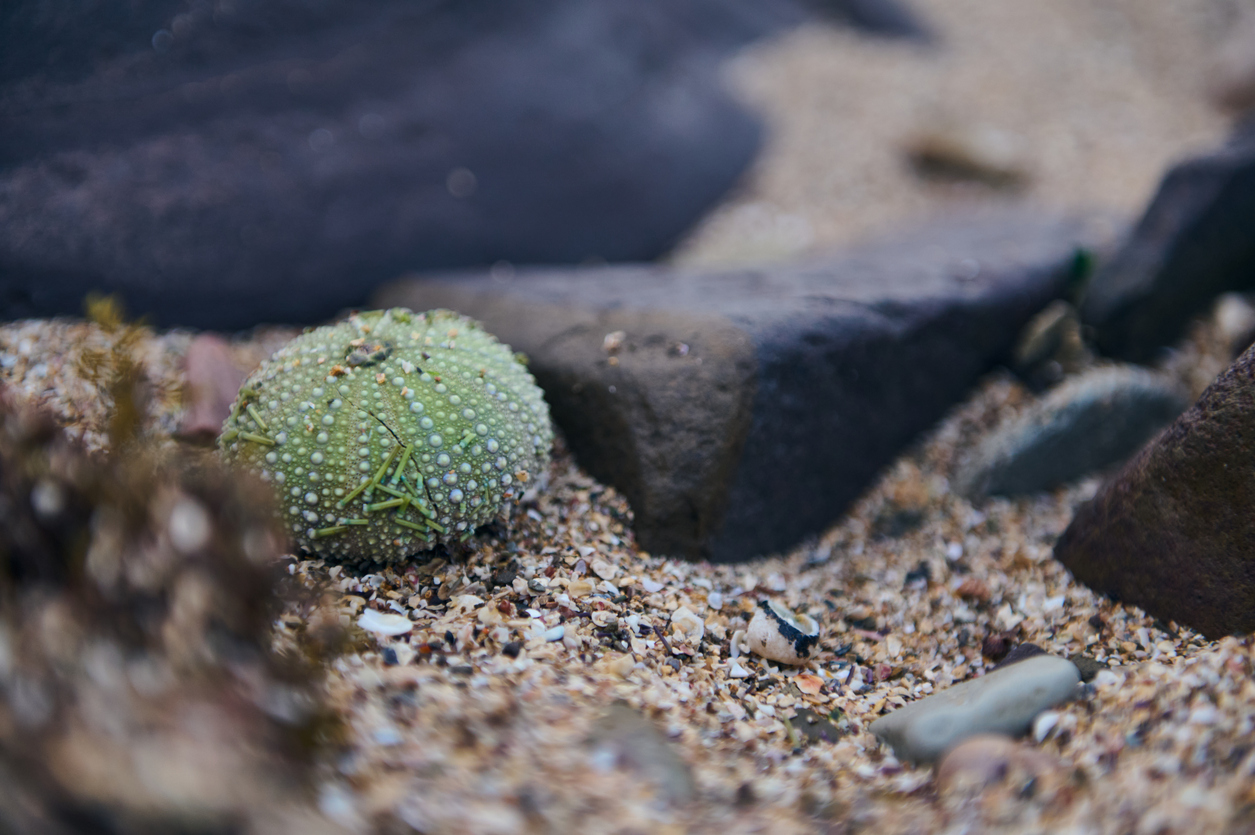
Sea urchins are fascinating creatures, with many different species out there to discover. Here, we’ll discover more about the green sea urchin (Psammechinus miliaris) which you can see right here at Blue Reef Aquarium Portsmouth.
This small invertebrate is a member of the echinoderm family, making them related to the likes of starfish and brittle stars.
Appearance and key features
This particular species of sea urchin has a green colouration with distinctive purple tips to its spines, giving it a striking appearance. The green sea urchin has an almost round and slightly flattened body, covered by a rigid shell known as a test. This is made from calcium carbonate.
The green sea urchin is around 4cm in diameter, similar to a golf ball. It is covered in short but strong spines that can be sharp, and has tiny tube feet that it uses to move around.
Habitat
The green sea urchin is typically found in the colder waters of the northern hemisphere, including the UK. They prefer rocky shores, tide pools and seagrass beds for protection and shelter. Green sea urchins are usually found in shallower water, down to depths of around 100 metres.
They are particularly common in the North Sea, the shallow area of the Atlantic Ocean located between the UK and northwestern Europe.
Hunting and feeding
Green sea urchins are omnivores and will feed by grazing on the likes of plants, algae and small creatures. This includes seaweed, seagrass, sea sponges, barnacles and small worms.
Sea urchins have a specialised jaw structure with strong teeth called Aristotle’s lantern, which it uses to scrape plants off rocks and chew their food.
Behaviour
Green sea urchins are typically nocturnal, becoming more active after sunset and leaving the safety of their crevices to find food. This is because they try to avoid bright light where possible.
They move by coordinating their spines and sticky tube feet in order to pull themselves across the seabed. Sea urchins have been known to cover themselves with shells, rocks and algae to help protect them from UV light, as well as offering camouflage from predators and to stop them from being swept away by stronger waves.
Their grazing is important for their ecosystem, helping to control plant growth and recycling nutrients through waste. This helps to balance the ecosystem through managing the density of underwater forests.
Green sea urchins live in tight clusters, and when the density is too high, they can actually overgraze the likes of kelp forests, resulting in bare areas known as an urchin barren.
Come and see green sea urchins at Blue Reef Aquarium Portsmouth
Here at Blue Reef Aquarium Portsmouth you’ll find a whole host of fascinating creatures, including our very own green sea urchins. Impress your friends and family with your newfound knowledge of these interesting invertebrates, which can be found in tank one in our native area.
Type
Echinoderm
What do they eat?
Mainly algae, along with small marine animals and encrusting organisms
Size
Up to 5cm
Water Type
Saltwater
Where are we?
Britain and Ireland, plus parts of the North Atlantic