
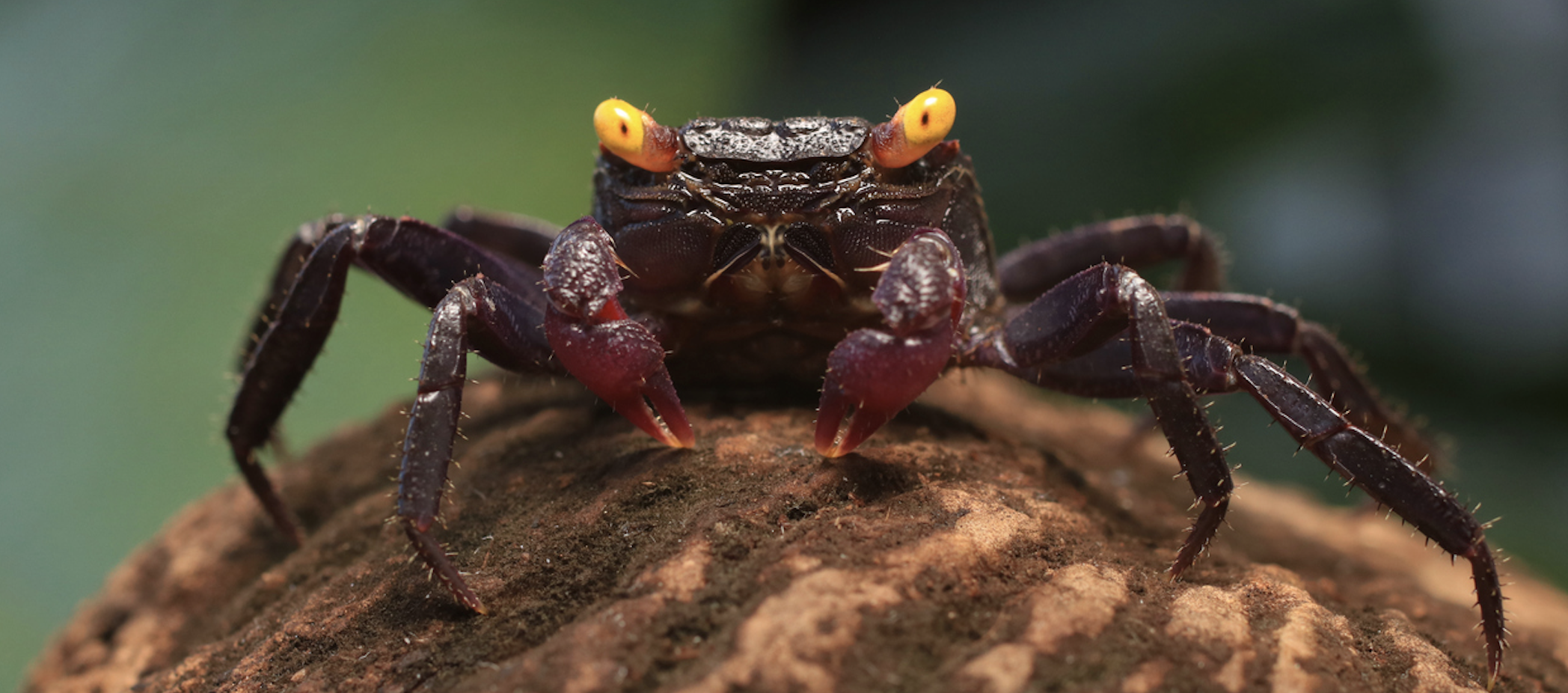
The vampire crab (Geosesarma dennerle) is a small, colourful semi-terrestrial crab belonging to the Sesarmidae family. Here you’ll find everything you need to know about these creatures, and where to find them at Blue Reef Aquarium Portsmouth.
Appearance and key features
Vampire crabs are known for their vivid purple bodies, which are also sometimes dark brown or black, with highly contrasting yellow or white eyes. This gives them their unique name. They are a small species, measuring around 2.5-5cm across their leg span. Like other decapods, vampire crabs have 10 legs in total with pincers that generally contrast with the body colour. The species displays sexual dimorphism, which means there is a difference between males and females. Males typically have larger, more prominent claws than females.
Habitat
Vampire crabs are semi-terrestrial, freshwater crabs. They need access to both land and water, typically living amongst the humid tropical forests and freshwater stream edges in Southeast Asia. Vampire crabs are known to shelter under leaf litter, rocks, roots and inside mud burrows.
They have modified gills that extract oxygen from damp air, and submerge themselves periodically to stay hydrated and help them moult. Females in particular use the shallow water to release their larvae.
Vampire crabs are primarily found in Indonesia, particularly Java.
Behaviour and characteristics
Vampire crabs are mostly nocturnal and typically elusive during the day. They will display activity during dawn and dusk, foraging during these low-light times of day. Vampire crabs are sometimes known to be skittish, quickly darting back under cover whenever they sense sudden movements.
The species does best in small groups. Males can be aggressive when it comes to territory and competing for things like water access.
Vampire crabs are also agile climbers and can scale steep riverbanks, rock crevices, tangled root systems and low-hanging vegetation. They are known for easily negotiating vertical surfaces
What do vampire crabs eat?
Vampire crabs are omnivores, scavenging for whatever they can find. This often includes insects and plant material, as well as detritus. Vampire crabs forage for food, grazing along the forest floor to find anything from decomposing leaves and algae to insect larvae. They will also feed on any fallen fruit.
Vampire crabs are low on the food chain, typically hunted by larger predators including larger amphibians, reptiles like snakes and shorebirds.
You’ll find our vampire crabs in the Freshwater Fun Zone, towards the end of the aquarium. As they’re nocturnal, look carefully among the leaf litter and roots they often tuck themselves away under cover during the day. Come and see them for yourself. Book your tickets to Blue Reef Aquarium Portsmouth and meet our vampire crabs, along with hundreds of other creatures from across the world.
Type
Crustacean
What do they eat?
Insects and plant material
Size
2.5-5cm leg span
Water Type
Freshwater
Where are we?
Indonesia