
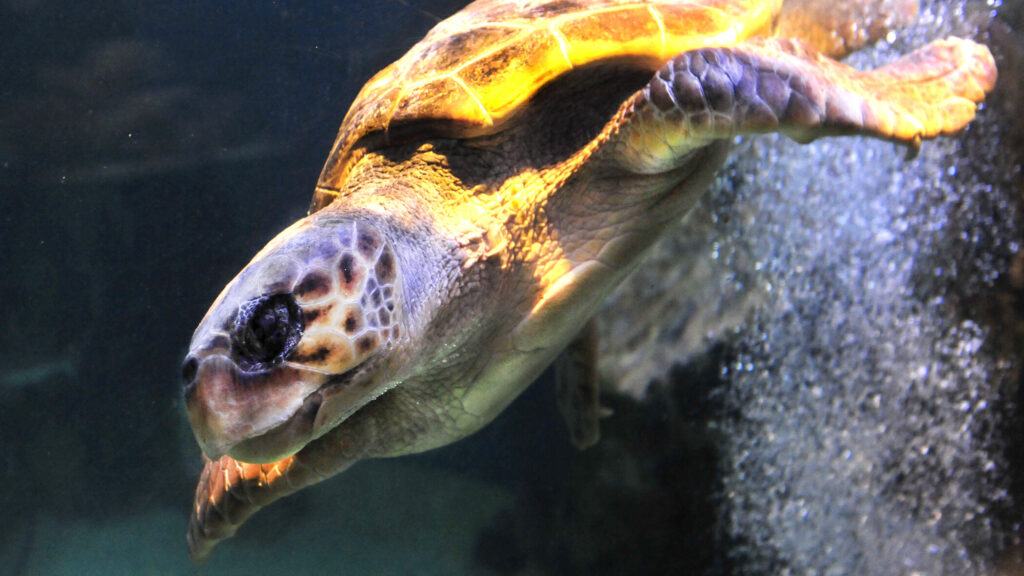
Omiros the loggerhead sea turtle, who was rescued off the coast of Greece having become entangled in discarded fishing gear, spent the last 17 years of his life as part of the Blue Reef Aquarium family. A big part.
Left completely blind after the incident, Omiros found ways to navigate by touch in his Ocean tank home, and as the years ebbed by, he opened more than a few eyes to the majesty and the plight of sea turtles and the wider issues facing marine life every day.
Let’s Talk Legacy
We can measure legacy in myriad ways.
It can be something intimate, carried on the smile of a memory like a delicate flower. It can be huge, reaching arms across the world to touch millions. It can resonate on the notes of a piano, be brushed in strokes across a canvas, or ride on winds of change across a planet.
And sometimes, it can be a five-foot sea turtle in Newquay, Cornwall.
Blue Reef Aquarium, when you think about it, seemed a fairly good place for such a legacy to happen. Blessed with exterior windows that took in the wild Atlantic, and interior ones that offered insight into the ocean’s many inhabitants.
A rugged corner of the land, whose roots burrow deep into Cornish soil, but also cast wide to the Atlantic sea. We live at its edges, make a living from it, we surf in it, fish in it, photograph it, and occasionally, we simply gaze out across it.
The sea is a part of everything in this neck of the woods.
And so too was Omiros. At least, that’s how big his presence felt. As though everything that happened under the roof of this aquarium on the edge of the sea, was fueled by a sea turtle delivered to us by fate and bad luck.
For 17 years, he found a home in his ocean tank. Completely blind, quietly going about his business while thousands upon thousands of people stood and watched.
He could not see them.
But they could to see him.
And, rather wonderfully, that seemed to be enough.
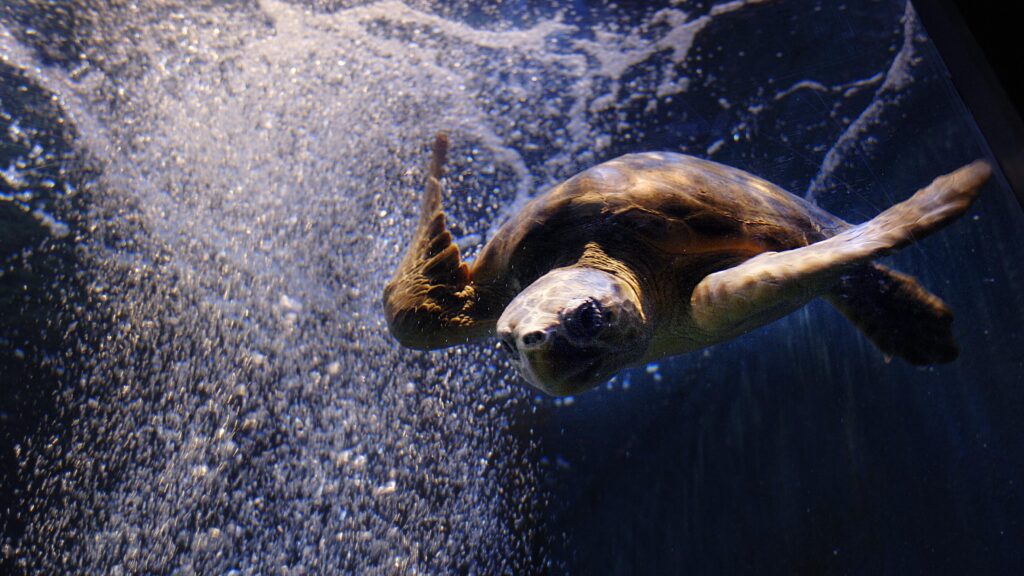
This majestic creature was safe again, and thriving, with an aquarium team who became like family, there to address his every need. And the people watching were moved by his story. The heartbreak of it, the rescue, the challenges Omiros managed to overcome, the human element that changed his path forever, and the human intervention that saved him.
There is something quite otherworldly about witnessing the glide of a sea turtle, fins cutting lines through glassy water, effortless beauty, innocent and pure. It affects people in ways they often don’t expect. It can be emotional, can induce open-mouthed awe, and can prove a catalyst for change.
Whether change is the shifting of a mindset, offering deeper understanding of real issues, or whether it spurs people to become pro-actively engaged to help marine life and more, Omiros proved instrumental.
Celebrity Status
It also didn’t take long for Omiros to become something of a celebrity. The frontman for the aquarium if you will. Like our very own Liam Gallagher, only less sweary and marginally better looking.
It even seems faintly ridiculous. The idea of a famous turtle that wasn’t a Teenage Ninja fighting crime in a New York based cartoon strip, but was simply living and adapting before our eyes.
We understand celebrity when it comes to actors, footballers, pop stars and that fella who cries a bit on Pottery Throwdown.
But a turtle?
Omiros did not give interviews. Nor did he release an autobiography or wear ‘Squiddly’ the latest fragrance by Hugo Bass.
And he never once turned up to the aquarium in sunglasses demanding a better dressing room. That’s just the marketing team.
Omiros simply was. No whistles and bells, no tricks, just him. And his presence was always enough.
The people fell in love with him.
The Journey
He arrived in Newquay in 2009, having been rescued by ARCHELON, the Sea Turtle Protection Society of Greece, off the Greek coast in 2007. He had been caught up in discarded fishing gear, an all-too-common human hazard in a world that is otherwise rather well designed for turtles. Those pesky humans again, right?
His injuries were severe. Omiros was left blind and unable to survive independently in the wild. Discarded fishing gear had nearly done for this magnificent creature, but survival still had a price. Despite the rescue, Omiros’s world had been dramatically reduced.
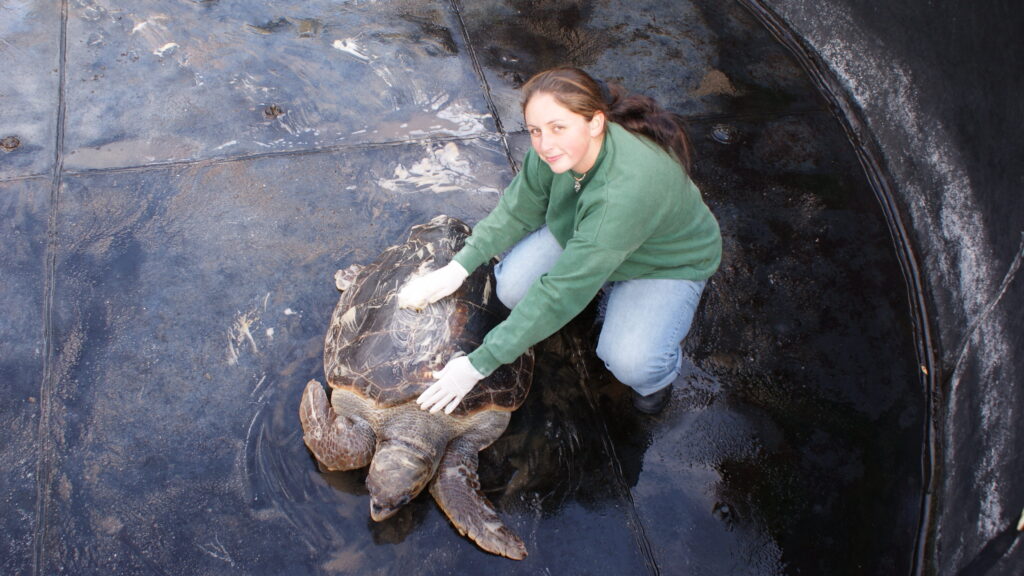
Omiros following his rescue off the coast of Greece
With solutions sought for Omiros to live a good happy life in the wake of terrible fortune, he eventually found his way to Cornwall.
It must have been quite a change. Whilst there are no boundaries to the sea, Omiros needed something different. He needed a safe haven, needed constant care and love, and that was exactly what Newquay had to offer.
And despite the trauma and change, Omiros adapted.
This was one of the things that made him so extraordinary. He couldn’t see, so he learned to feel his way around. He mentally mapped the huge Ocean tank until it became a place that he knew through touch. He learned its boundaries, its features, its rhythms, the fish that shared his space. Omiros may have lost the ability to see his new world, but he found a way to navigate it still.
There is something profoundly moving about that. Life finds a way. I’d love to think that quote is tied to a great philosopher, but I’m pretty sure it’s from Jurassic Park and has a different connotation, but hey, life did find a way.
Omiros quickly became the heartbeat of the aquarium. Miles from home, blind, but learning and thriving as part of a new found family, he carried an aura with the sort of effortless grace modern influencers could only dream of.
Family Matters
The aquarists bonded quickly. Of course they did, how could you not. They quickly became tuned to his personality and quirks and no doubt, he with theirs. They knew his routines, his habits, his tastes for food and how grumpy he’d become when the menu wasn’t quite what he wanted.
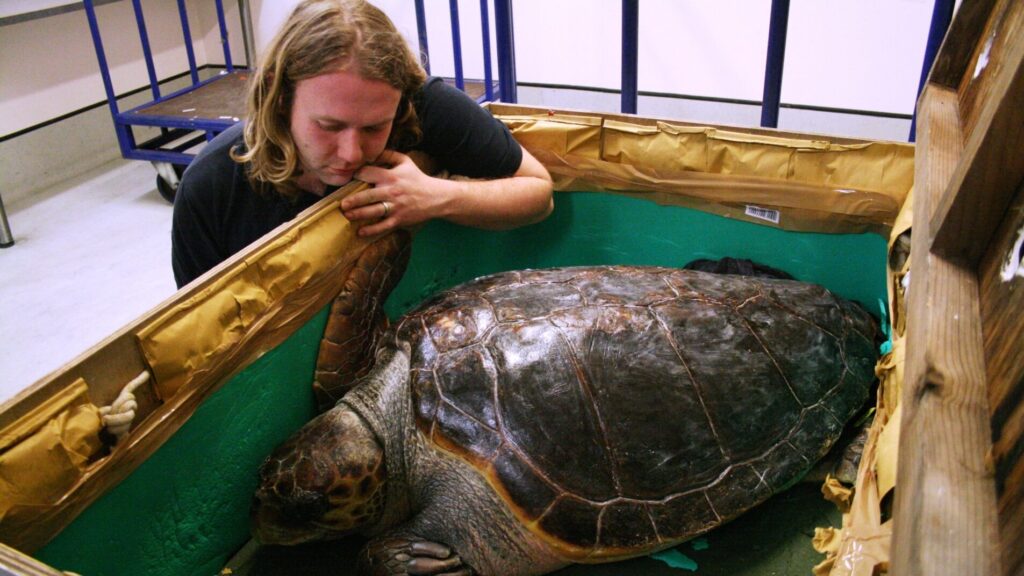
Omiros with Ben, shortly after arriving in the UK
And visitors knew him too.
That is one of the most wonderful things about aquariums. You can form an attachment to an animal just by spending time as an observer.
You might see it for a few minutes. It might swim past you inches from your nose, it might sometimes appear to be looking right back at you, measuring you. You might point at it. Gaze for a moment. Take a photograph, catch the glare from the glass and end up with 50% fish and 50% your own awestruck face.
But you remember it. It means something. It moves you. For a moment the white noise of life quietens to blissful peace. Aquariums are blessed with moments such as these.
Omiros was a particularly memorable one because his presence came with questions?
“Why can’t he see?”
“What happened to him?”
And…
“Could he ever go back to the sea?”
And there was the slice of uncomfortable reality forever attached to this magnificent creature. Omiros was there because he had been injured by something humans had put into the ocean. His life had been changed by the careless nature of humanity and the carefree nature of chance. But his plight was enough to engage minds and open eyes to the struggles faced by countless species every day.
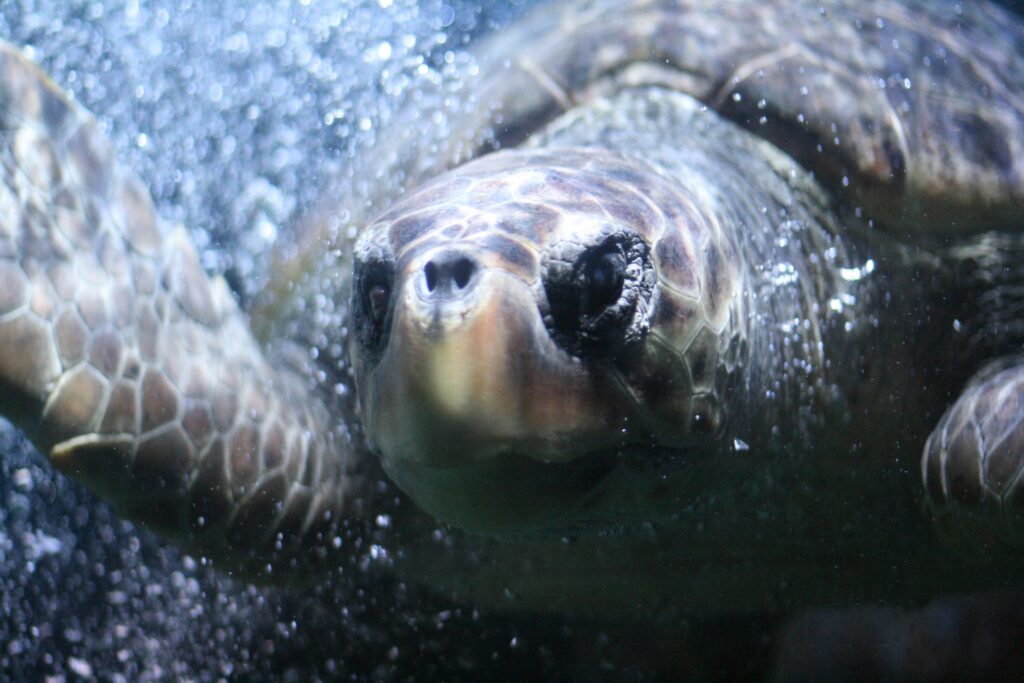
His story was conservation education without the PowerPoint.
You just had to look at Omiros.
There he was, testament to everything.
A magnificent sea turtle who should have been out there somewhere, travelling enormous distances through warm Mediterranean waters, instead living in Cornwall because discarded fishing gear had changed the course of his life.
Suddenly, the problem of pollution wasn’t abstract. It had a name.
Omiros.
Marine pollution is a phrase that can become lost in the dense forest of multiple man-made issues.
Omiros is real. A sea turtle with a story.
And people tend to care considerably more about that.
Inspiration
Over the years, countless children encountered Omiros. Some would have been fascinated by turtles already, first steps taken on the way to a career in the care of animals, or in combatting ocean pollution and championing marine conservation. Omiros being another seed in what would be a blossoming life.
Others probably wanted to see sharks, and found those mighty fish proved an equal catalyst in propelling future careers.
Some were probably primarily interested in finding the gift shop.
But there he was. Swimming. Blind. Adapted. Uncomplaining. Inspiring.
And perhaps without realising it, those children were learning something rather important. Conservation isn’t just about saving spectacular animals in spectacular moments. It is also about what happens after the rescue.
Sometimes the animal gets better and goes home. Sometimes it doesn’t.
There are times when saving an animal means accepting that its life has changed permanently and now we must give it the best possible life under new circumstances.
Omiros was one of those animals. We owed it to him.
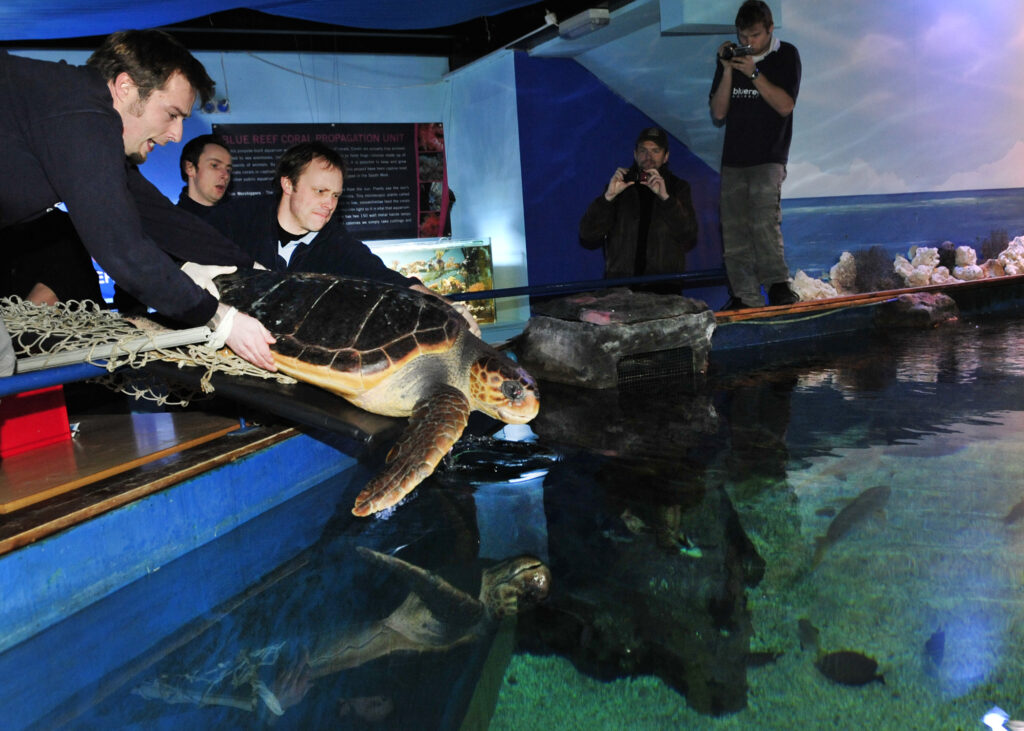
First introduction to the Ocean Tank
The Legacy
The finale to his plight wasn’t a dramatic release into the Mediterranean, accompanied by stirring music and a slow-motion camera. It was Blue Reef Aquarium, Newquay. It was a tank he could navigate without sight, it was a team who knew him and cared to know him. It was food arriving on time, it was thousands of strangers stopping to look at him who left feeling a connection.
Over 17 years, it became a remarkably good life. A life that many travelled with him as they moved from wide-eyed child to adulthood, always finding time to pay a visit to their favourite Loggerhead Sea Turtle. Like old friends reuniting under a Cornish sky.
And this is just how big a presence Omiros was at Blue Reef.
He became part of people’s personal history. A face on holiday snaps. A part of school visits. A Newquay local who, given half the chance, would have ridden the Atlantic swell as good as any.
Families visit from far and wide. They may not remember everything about that holiday. They probably don’t remember what they ate. How busy the town was. They certainly won’t remember where they left the car.
But they might remember the turtle. Remember being told that he was blind. Remember watching him move through the water.
And one day, perhaps years from now, they will bring their own children to Blue Reef. They will walk through the aquarium, will see the tank, and say:
“There used to be a turtle here.”
And then they will tell the story of Omiros.
That is legacy.
Omiros leaves behind something much more difficult to measure. He leaves behind the people who cared for him. He was part of the family, and a character who had become woven into the history of the building. The sort people would be excited to see.
The sort whose absence you notice.
The tank will still be there, teeming with glorious life and colour. Sharks will still stalk the edges and moray eels will dance through the rocks.
But there will be a gap.
And for a while, people will notice it.
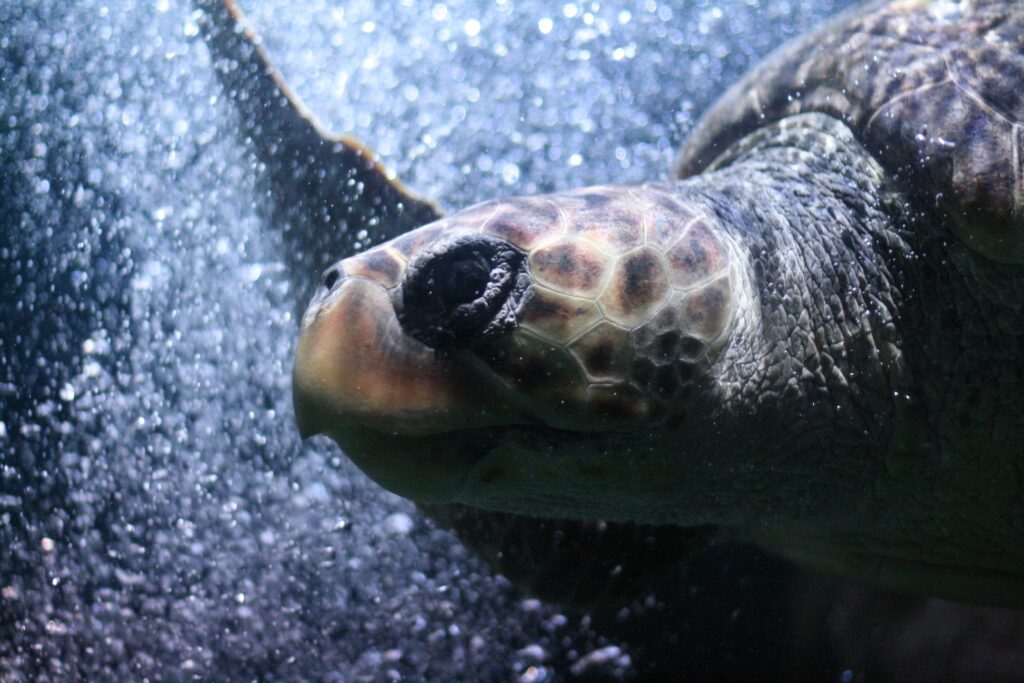
The Greatest Tribute
Perhaps the greatest tribute to Omiros is that he made people stop.
We live in a world in which there is an almost limitless number of things demanding our attention. Notifications, news, emails, videos, advertisements, someone on Facebook being furious about how somebody else has parked their car.
And then there was Omiros.
He swam past. And people stopped and watched.
For a few seconds, they looked at an animal they might otherwise never have encountered. For a few seconds that were present.
They learned his name and what had happened to him. They learned about loggerhead turtles. Perhaps they learned something about fishing gear and the length of time human rubbish can survive in an ocean without degrading.
And perhaps they went home and thought differently about things. We don’t know how many minds Omiros changed. We can’t measure every child who became a little more interested in the ocean because they met him. We can’t count every conversation he started.
But we don’t need to.
Because conservation is, in the end, a rather human business. And it starts with finding a connection and caring enough to want change. For 17 years, Omiros gave people that connection.
He arrived in Cornwall because something had gone terribly wrong, but he stayed because people cared for him. And in the process, he became an ambassador for a world he could no longer see. A blind turtle from the coast of Greece ended up becoming a small but significant part of the story of Newquay.
There are grander definitions of legacy, but I think there is something rather lovely about this one.
For a sea turtle who spent the final 17 years of his life unable to see the world, Omiros certainly left an extraordinary number of people looking at it differently.