
This wild ride we call life will offer up myriad choices for ways to make a living. Some of the options are the means to an end, some are well-worn routes, tried and tested in the bid to nudge numbers up on the bank account, and some are just part of the daily grind we endure before finding solace in a sofa as evening settles in.
But then, there are the others. The special roles that are not so much a job, as they are a calling.
Let’s Talk Aquarists
When we press our face to the glass in an aquarium, we might have a general assumption that the fish are just…there.
Swimming around, loving life, existing. It sounds almost idyllic to be fair. I mean, we’re sure someone probably sprinkles a little food in from time to time to keep them well-nourished functioning fish, but beyond that, it’s job done. Right?
However, things might not be quite as clear as the water in the tanks.
Because, behind every clear tank, every healthy, happy fish, every lazing reptile, every smile on the faces of the visitors, is an aquarist working unseen and often unsung miracles and magic.
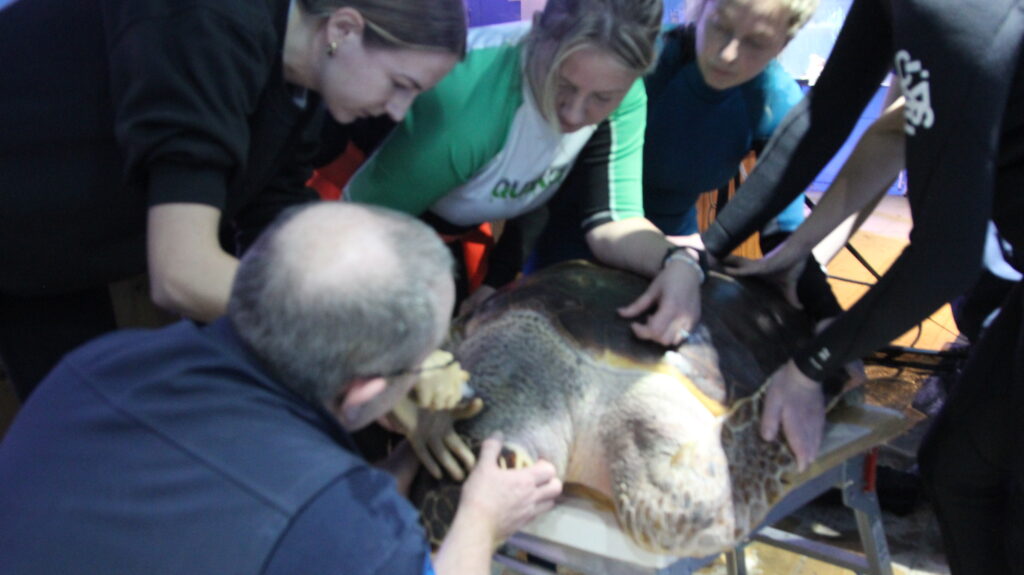
An aquarist who has spent the morning testing the water chemistry, fixing filtration pumps, preparing specialised diets, noting and logging animal behaviour, caring for the sick, settling in the new arrivals, and trying to persuade a stubborn turtle away from a filter intake…and wow, is that turtle stubborn!

Life in the Fish Lane
An aquarist is part animal keeper, part marine biologist, part plumber, part electrician, and occasionally, when things get really interesting, part detective.
Because, when something goes wrong in a tank, it’s usually subtle. Maybe a fish stops eating. coral closes up, the water looks slightly cloudy, and somewhere in the tens of thousands of litres, something has changed. You thought Sherlock Holmes was good. He’s got nothing on an aquarist.
When life does its thing and chaos makes a call, the aquarist is the problem solver extraordinaire. Often seeking solutions against the ticking clock, like the wildest episode of Countdown you ever saw. Averting disaster, plugging leaks, rejuvenating fish, all while the visitors amble by unaware.
Life for the aquarist is rarely boring.
The First Thing you Learn…Water is Everything!
As if having the lives of hundreds of fish and animals on your shoulders wasn’t enough of a challenge, did you know the water is a daily managed mission of its own.
In fact, if you ask aquarists what their job really is, many will tell you the same thing:
They look after fish. They look after water.
Get the water right and the fish are usually fine. Get the water wrong and everything else can spiral very quickly.
A huge part of the job involves testing:
- pH levels
- Salinity
- Ammonia
- Nitrites
- Temperature
- Oxygen levels
It starts to feel less like working in a zoo and more like working in a laboratory that happens to contain sharks, which outside the realm of James Bond, is rarely seen.
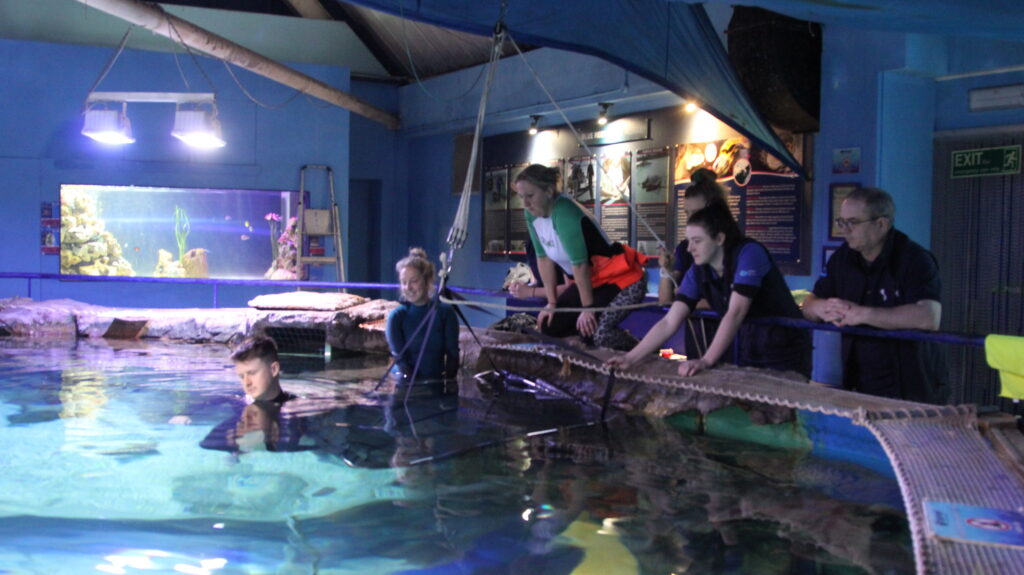
Here in Newquay, at Blue Reef Aquarium, our own aquarists are in a slightly fortunate position. With our building being perched on the edge of Towan Beach, and the tides doing their ebb and flow thing, it means our aquarist team can actually pump water directly from the ocean into our tanks. The real stuff.
This means our fish and animals are cutting routes through genuine Atlantic saltwater.
It makes life a little easier in ensuring the chemistry is correct, but it does mean when high tide hits it all hands to the pump…literally.
A Day in the Life of an Aquarist
The day begins before the aquarium opens to the public. The building is quiet, painted in a beautiful serenity that feels almost other-worldly. Soaked in calming shades of blue that would have a mindfulness coach rejoicing. It is peace. It is gentle.
Save of course, for the aquarist who is already hard at work trying to make sure every single resident of every single tank is happy and healthy, and that every cog on every piece of machinery and electronic device is purring like a kitten…or, a catfish perhaps.
The aquarist day from start to finish is fuelled by passion. It takes a huge empathetic heart to do what the aquarist does. It takes patience and incredible depth of knowledge, it takes an ability to be reactive when things go awry, and it takes a love of wildlife that lights up the whole place.
With great power, comes great responsibility, isn’t just a note for Spiderman, it’s a weight that every aquarist carries daily. Imagine trying to run a daycare centre where half the kids there would happily eat the other half. Or where a slight fluctuation in the quality of the air would have them gasping for breath. How’s that for great responsibility?
The day is diverse, it sometimes involves di-vers and is rarely blessed with any downtime.
A typical day might include:
- Preparing food for different species
- Feeding fish
- Giving educational talks to visitors
- Cleaning tanks and viewing panels
- Checking pumps and filtration systems
- Testing and adjusting water quality
- Observing animal behaviour
- Writing care and health reports
- Answering visitor questions
- Helping with animal moves or new exhibits
- Sharing an enthusiasm which sparks imagination in young minds
Some days are routine. Some days involve moving a shark. If life is about variety, the aquarist is embracing it with both hands.
It’s Not Just Fish
For the aquarist, despite the job title’s undoubted watery connotations, the reality is that they will be overseeing a variety of different animals and habitats, including:
- Sharks and rays
- Jellyfish
- Reptiles
- Octopus
- Seahorses
- Coral reefs
- Sea turtles
- Freshwater tropical fish
- Crabs, lobsters, and shrimp
- Aquatic plants and entire ecosystems
The aquarist is in a constant state of flux. Forever learning, discovering and challenging themselves to be the very best they can be.
The Job is Way More Diverse Than People Expect
One of the surprising things about the job is how technical it is. It isn’t all fins and flippers, half the time life is about cogs and wheels. Aquarists often spend as much time fixing equipment as they do feeding animals. Pumps break. Filters clog. Lights fail. Sensors stop working. Pipes leak.
An aquarium is basically a life-support system for an entire ecosystem, and aquarists are the people who keep that system running. There’s that ‘Great Responsibility’ thing again.
They are, in a very real sense, keeping a small piece of ocean alive indoors.
Why People Become Aquarists
It is not a job people usually choose for money or fame. Most aquarists become aquarists because they are fascinated by water, animals, ecosystems, and the quiet, slow world beneath the surface. They have a natural desire to care for these creatures, and an empathy for the wilder world and all its many colours.
It’s a job for people who are patient, observant, practical, and curious. People who don’t mind getting wet, fixing pumps, testing water, and spending long periods watching fish to see if one of them is behaving slightly differently from yesterday. But equally, it is a job for those seeking days that challenge in the best ways, that never feel routine, that fill hearts with joy.
The Hidden Keepers of Underwater Worlds
So, the next time you stand in front of a huge aquarium tank, and everything looks calm, clean, and effortless, remember that somewhere behind the scenes there is an aquarist sweating.
An aquarist up to their elbows in machinery repair, or testing water, preparing food, checking filters, giving talks, writing reports, and making sure that thousands of animals and plants continue to survive in a carefully balanced artificial ocean.
Aquarists are not usually the people you see.
But without them, there would be no aquarium at all.