
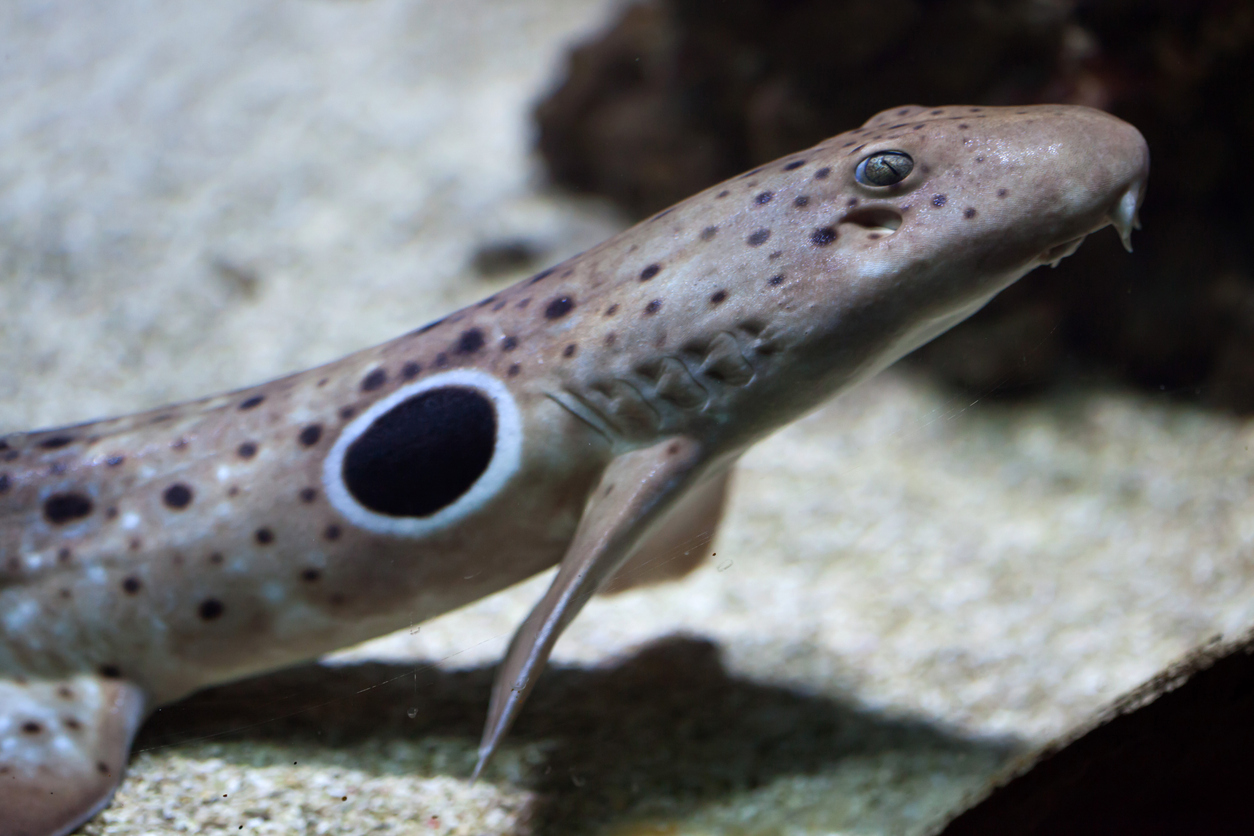
This small, slender shark belongs to the family of carpet sharks, and has some fascinating features that are certainly worth learning about. With epaulette sharks right here at Blue Reef Newquay, let’s have a look at what makes this species so unique.
What is an epaulette shark?
The epaulette shark (Hemiscyllium ocellatum) is a species in the long tailed carpet shark family within the order Orectolobiformes, meaning it’s closely related to the likes of nurse sharks and wobbegongs.
Key appearance features
The epaulette shark was named for the white-ringed black spot behind its pectoral fin, like a military epaulette. It’s a slender shark typically brown or cream in colour with small dark spots on its body, with a short, rounded snout. It also has two similar sized dorsal fins and are typically no more than 1 metre in length.
Native habitat and range
The epaulette shark is endemic to the Great Barrier Reef, found in the western Pacific Ocean along the coast of Australia and New Guinea. They prefer tropical, shallow waters and can often be found swimming within water no deeper than 40 metres.
Amazing survival adaptions
One of the most fascinating adaptations of the epaulette shark is its ability to “walk” along the seafloor. Due to their habitat, epaulette sharks commonly have to navigate the obstacles of the coral reef system, and have evolved to possess adaptations in their fins that help them function more like feet. This also helps them to get across the cracks and crevices of the coral reef and shallow waters.
As well as this, epaulette sharks are able to survive for periods of time with little or no oxygen. Epaulette sharks can sometimes become trapped in pools created by low tide, which have incredibly low oxygen in the water. The species have evolved to slow down their heart rate and breathing, as well as gradually limiting the blood flow to the brain to help them in these conditions.
Epaulette shark conservation status
The epaulette shark was last assessed for the IUCN Red List in 2015, when it was classified as Least Concern. However, the primary threat to this species is ocean warning from climate change, as well as habitat degradation and overfishing. While they are a resilient species, the likes of coral reef damage and pollution still poses a great risk for this unique animal. It has been found that higher temperatures can affect mortality and growth rates in young epaulette sharks.
4 additional facts about epaulette sharks
There are a number of other fascinating facts about the epaulette shark, some of which include:
- Epaulette sharks are oviparous, which means they lay eggs. They typically produce eggs in pairs, with two eggs laid per day over a number of days.
- They feed mostly on worms, small fish and crustaceans.
- Epaulette sharks are most active at dusk and dawn, making them a crepuscular species. They feed mostly at night.
- It has been reported that they are not afraid of humans and will probably nip if handled, so it’s important to respect this species as you would any other!
You’ll be able to see the epaulette shark for yourself right here at Blue Reef Newquay, in the last display as you leave the aquarium! They share the display with the incredible lionfish. It gives you a unique close up as you immerse yourself in the underwater world – if you’re lucky, our epaulette sharks might swim right above you! Book your tickets today and come and put your new knowledge of our sharks to the test.
Type
Shark
What do they eat?
Worms, small fish and crustaceans
Size
Up to 1 metre in length
Water Type
Saltwater
Where are we?
Great Barrier Reef