
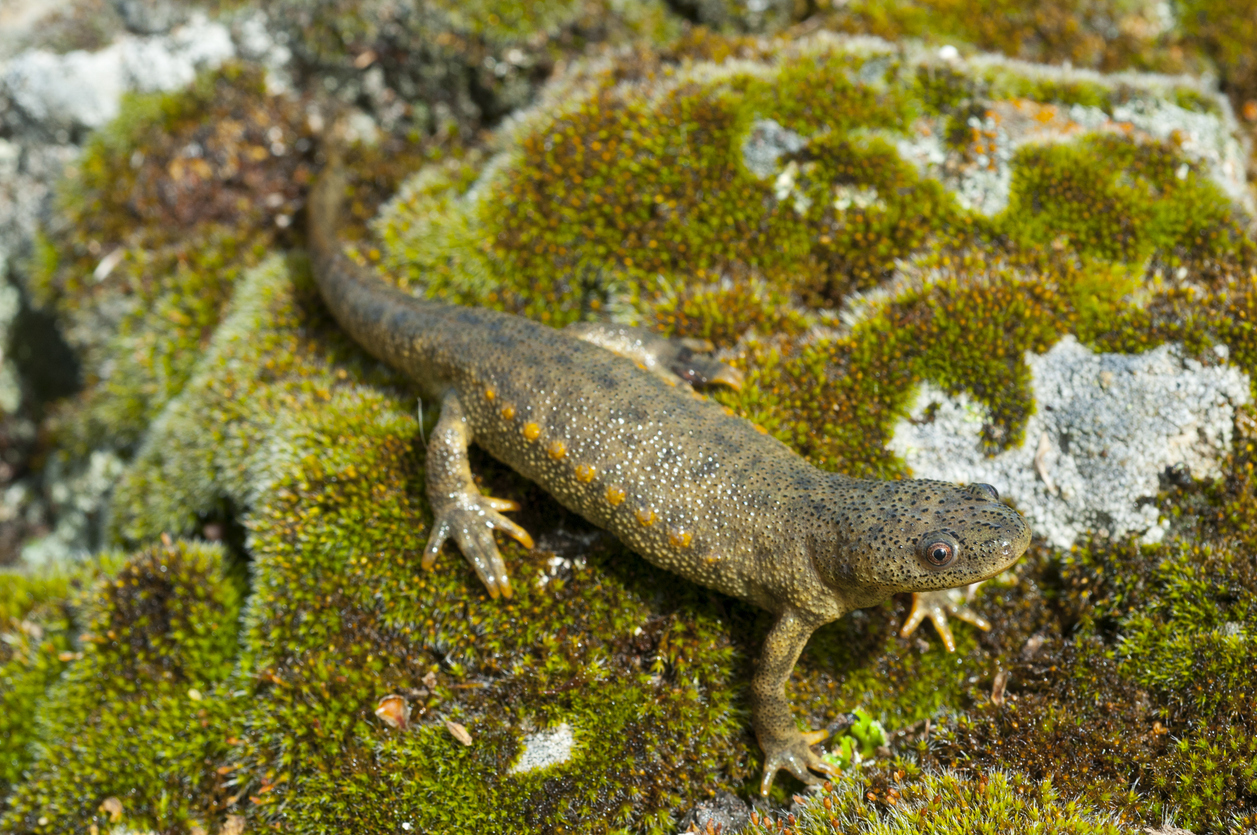
Our aquarium is filled with more than just fish. Some of our most interesting creatures, while spending a lot of time in water, aren’t fish at all. Let’s take a look at one of our amphibians, the Spanish ribbed newt.
What are Spanish Ribbed Newts?
Spanish ribbed newts (Pleurodeles waltl) are a type of amphibian in the salamander subfamily. They’re sometimes referred to as the Iberian newt because they can be found in the central and southern Iberian Peninsula and northern Morocco. They’re also the largest species of newt in Europe.
Key Appearance Features
The Spanish ribbed newt is a dark-coloured species of newt with orange spots along its flanks. They can grow up to 30cm (12 inches) in length, with females typically growing to be larger and more bulbous, particularly when carrying eggs.
Unlike fish, newt larva have external gills that stick out from the sides of their necks, giving them quite a distinct look. Above their gills, newts have beady, little eyes, which are able to regenerate if they are damaged, known as Wolffian regeneration.
Unique Defence Mechanism
Despite being quite small animals, Spanish ribbed newts possess an incredible defence mechanism. When they are threatened, they can push their ribs through their bodies to expose a row of bones that act like poisonous barbs.
Once the threat has gone, they can push their ribs back, and they experience no long-term damage with their incredible regeneration capabilities taking care of the rest.
Their primary predators are snakes, large fish, herons, and mammals such as foxes or hedgehogs.
Native Habitat
Newts need a near-constant source of water in order to keep their skin moist, particularly for breeding and when they are very young. In Spain, Portugal, and Morocco, you’ll find the Spanish ribbed newt in mud and among the stones of ponds and lakes.
They use this habitat to hunt for animals like worms, insects, larvae, small fish, and snails.
Spanish Ribbed Newt Conversation Status
Unfortunately, within Europe, the Spanish ribbed newt is now considered near-threatened due to significant habitat loss, with numbers dropping. Although they’re hardy animals, they face the same habitat-threatening changes that are happening globally.
However, when looking on a global scale, which includes Morocco, Spanish ribbed newts are of Least Concern on the IUCN list.
Learn more about us at Blue Reef Newquay
Blue Reef Newquay is a fantastic place to learn about the animals that we share the Earth with. You can find the Spanish ribbed newt in the amphibian wall of the Freshwater section of the aquarium.
If you’d like to learn more about the Spanish ribbed newt, book your tickets now and don’t forget to ask our team any questions you have about the animals.
Type
Amphibian
What do they eat?
Worms, insects, larvae, small fish and snails.
Size
Up to 30cm
Water Type
Freshwater
Where are we?
Europe