
Moray eels are snake-like marine fish, with over 200 species found across tropical and temperate oceans. In this blog, we’ll find out more about these fascinating creatures that make up just one of around 19 families of eels.
What is a moray eel?
Moray eels (Muraenidae) are true eels that originated over 100 million years ago, during the late Cretaceous period. They have since evolved and diversified into their modern reef habitats, around 50 million years ago.
Moray eels are ray-finned fish, part of the order Anguilliformes which means they are known as true eels. This order also includes freshwater eels and conger eels. Despite having a snake-like appearance, they are not related to snakes in any way!
What do moray eels look like?
While the finer details of their appearance can differ depending on the species of moray eel, typically they are characterised by their long, slender bodies with no scales. They also have a continuous dorsal fin that merges with their tail.
Moray eels are fierce looking, with large teeth suited to their diet. They also have a hidden second set of pharyngeal jaws in their throat that can extend forward to help them hunt and feed.
When it comes to colouration, they can vary from black, yellow, brown and also patterns included spotted, banded or striped. However, moray eels are covered in a protective mucus which can affect their colour, such as the green moray eel (Gymnothorax funebris) which is actually brown under its coating.

6 impressive facts about moray eels
Want to learn more about these elusive creatures? Here’s some extra impressive facts about their habitat, behaviours and more.
Moray eels are known for having poor eyesight and are essentially colour blind, and can’t see in bright light. To compensate, they have a great sense of smell instead.
They are typically solitary creatures, but they have been known to hunt alongside grouper fish, namely giant moray eels. This is because the moray eels can help to find prey in holes and crevices that fish can’t reach.
If you see a moray eel swimming around with its mouth open, it’s not looking to attack. It’s actually how they breathe! Moray eels don’t have any bony gill covers like fish, so they pump water through its gills with its mouth instead.
The largest moray eel is the giant moray (Gymnothorax javanicus), which can grow up to 3-4 metres in length. They are native to the Indo-Pacific region, thriving in the tropical coral reefs and lagoons. In contrast, the smallest moray eel is the Snyder’s or dwarf moray eel (Anarchias leucurus) which reaches a length of around 11cm.
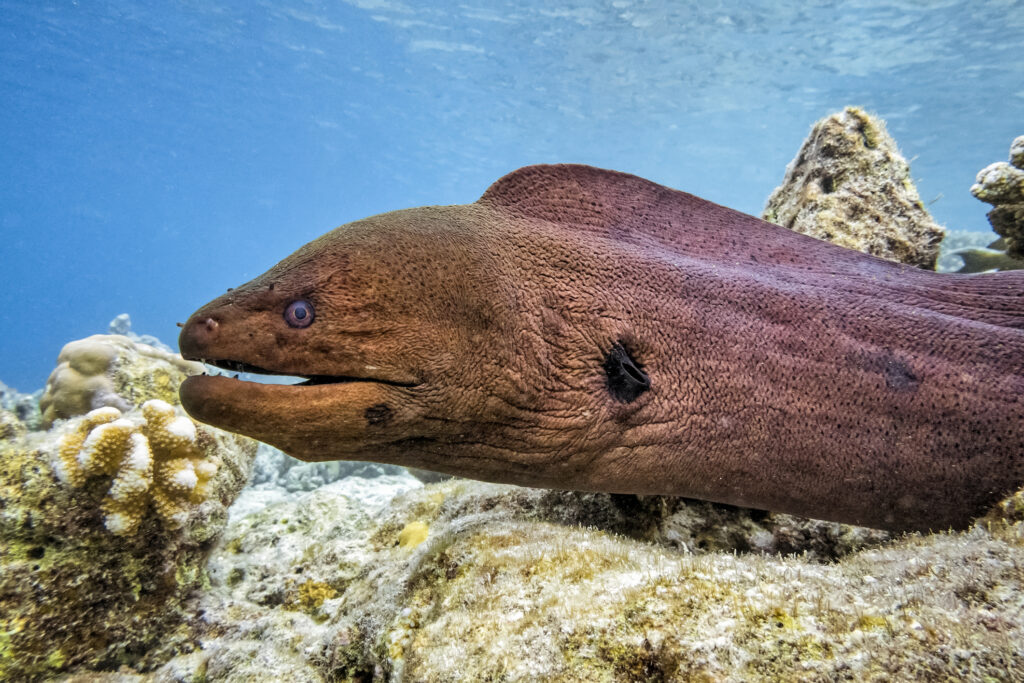
Moray eels are known to be apex predators within their coral reef ecosystems, helping to control the populations of smaller fish and crustaceans.
While moray eels aren’t venomous, some species have toxins in their mucus. Some larger species can accumulate ciguatoxins from their diet, which can cause illness if the eel is then eaten.
Visit moray eels at Blue Reef Newquay
Looking to put your new knowledge to the test? Here at Blue Reef Aquarium Newquay we are home to a couple of fascinating species; the laced moray eel and zebra moray eel.
The laced moray eel (Gymnothorax favagineus) is also known as the leopard or honeycomb moray, thanks to its colouring of white with dense black spots. It’s one of the larger species of moray eel, typically found amongst coral reefs and rocky coastal waters of the Indo-West Pacific area.
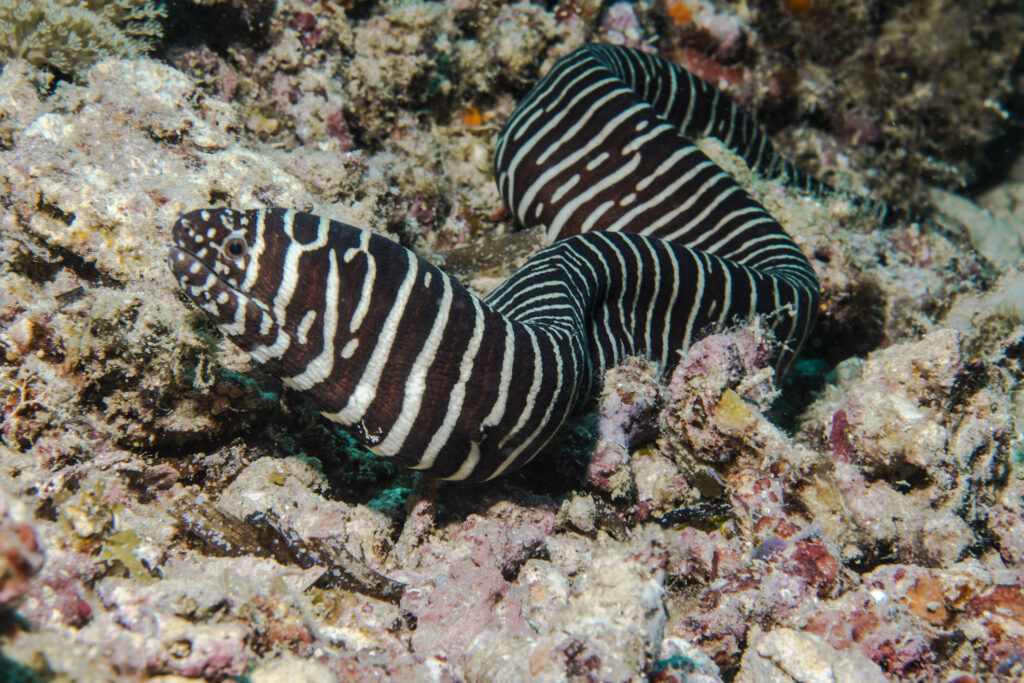
The zebra moray eel (Gymnomuraena zebra) has striking black and white stripes, as expected. It has unique flat teeth for crunching hard shells and is usually found in regions across East Africa and the Red Sea to the Galápagos.
Come and see if you can spot them in our Ocean Tunnel and book your tickets today!